When Three Years of Chest Tightness Met the Logic of Traditional Chinese Medicine
A Case Study on Structural Alignment and Internal Regulation in Traditional Chinese Medicine
Within the precise framework of modern diagnostics, there are conditions that simply don't show up on tests.
A client once came to Shou Ren Zhai after experiencing persistent chest tightness for three years. He had consulted cardiologists and pulmonologists, undergone extensive examinations, and accumulated a stack of reports. Each time, he was told the same thing: No detectable structural abnormality.
Yet the suffocating sensation — as if a heavy stone were pressing on his chest — was very real.
Although invisible to imaging equipment, it was impossible to ignore in daily life.

Many people view Traditional Chinese Medicine (TCM) as experiential, even mysterious. In reality, its clinical reasoning follows a clear structural logic.
In this case, the issue did not lie within the heart or lungs themselves, but in the structural framework supporting the chest cavity.
If we compare the heart and lungs to residents living inside a room, modern medicine often focuses on whether the residents are ill. TCM, however, also examines the condition of the room itself. If the beams are tilted and the walls misaligned, the space becomes compressed. Even perfectly healthy residents would struggle to breathe in such an environment.
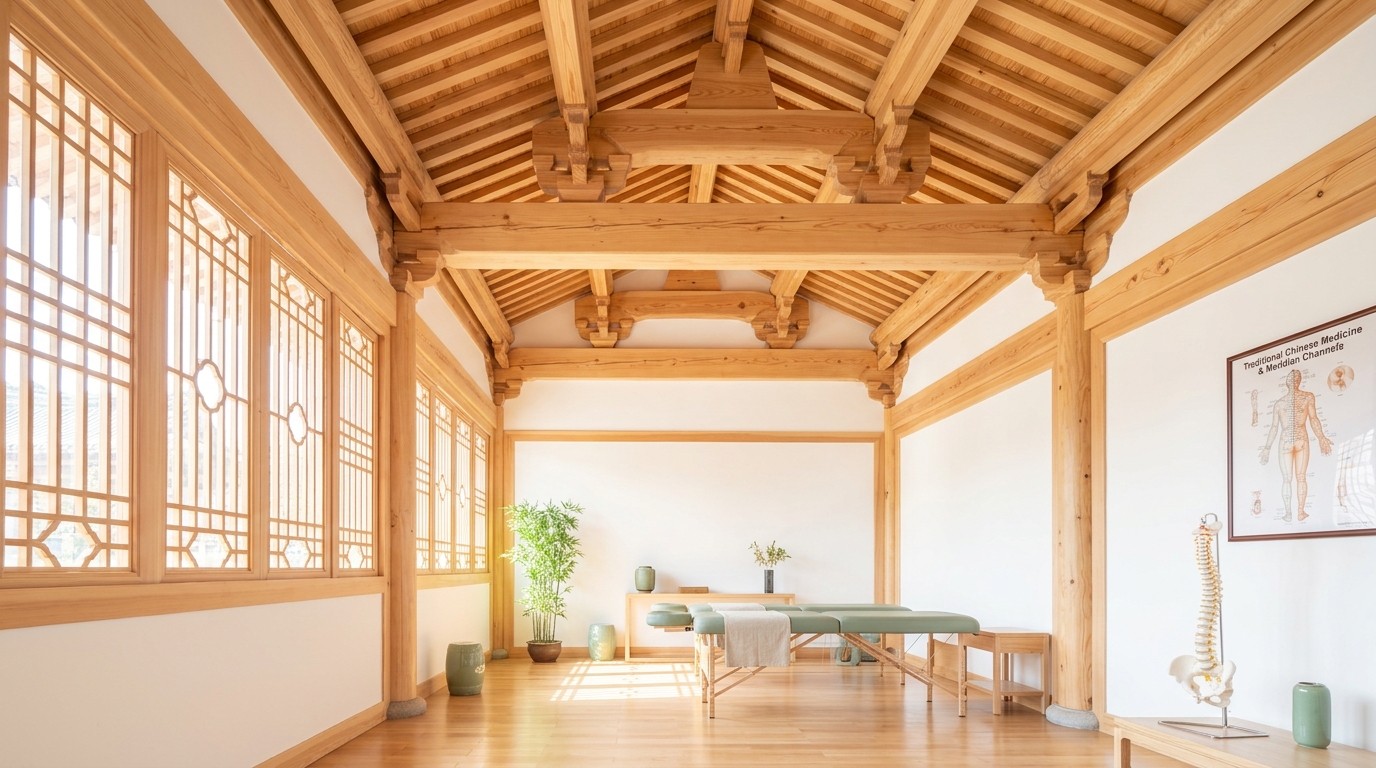
After a referral, the client came to see Mr. Kelson Sun at Shou Ren Zhai.
Through traditional diagnostic methods, an imbalance was identified at the fourth thoracic vertebra — noticeable lateral deviation accompanied by stiffness.
From a structural TCM perspective, two mechanisms were involved.
First, mechanical compression. Spinal instability can limit the natural expansion of the rib cage, directly affecting breathing mechanics.
Second, functional stagnation. In TCM theory, the spine is not only structural support but also a central pathway for the body's regulatory network. When joints are misaligned and fascial layers adhere, circulation and regulatory flow may become restricted. The classic TCM principle states: “Where there is blockage, there is discomfort.” The sensation of tightness was the body's signal that something was not moving as it should.
Our approach addressed both aspects.
Externally, manual structural adjustment techniques were used to restore subtle misalignments in the thoracic spine — much like straightening a leaning beam. This helped relieve mechanical compression within the chest.

Internally, herbal support was introduced. Long-term structural imbalance had led to a buildup of what TCM describes as phlegm-damp accumulation in the chest region. A modified form of Gua Lou Xie Bai Ban Xia Tang was selected — traditionally used to open the chest, promote circulation, and regulate upward counterflow. Working together, the formula supported the body’s natural clearing processes.
On the third day of follow-up, the patient took a deep breath and said, “For the first time in years, it feels smooth.”
This was not a miracle. It was the result of restoring balance within a mechanical and regulatory system.
The human body functions as an integrated structure. When practitioners step beyond isolated symptom treatment and instead look for underlying points of imbalance within the whole system, complex and persistent discomforts often become clearer and more manageable.
One strength of TCM lies in its ability to recognize and address subtle structural imbalances — long before they evolve into measurable pathology.
This understanding — not only observing what happens, but also understanding why — is part of what has allowed TCM to endure for thousands of years.